
Explore definitions, key differences, pros/cons, implementation in Express.js, Nest.js, Spring Boot, Laravel, .NET, and more. Learn hybrid blending, migration processes, and real-world examples to choose the right architecture for your next project. Perfect for developers and CTOs at Kathmandu Infotech.
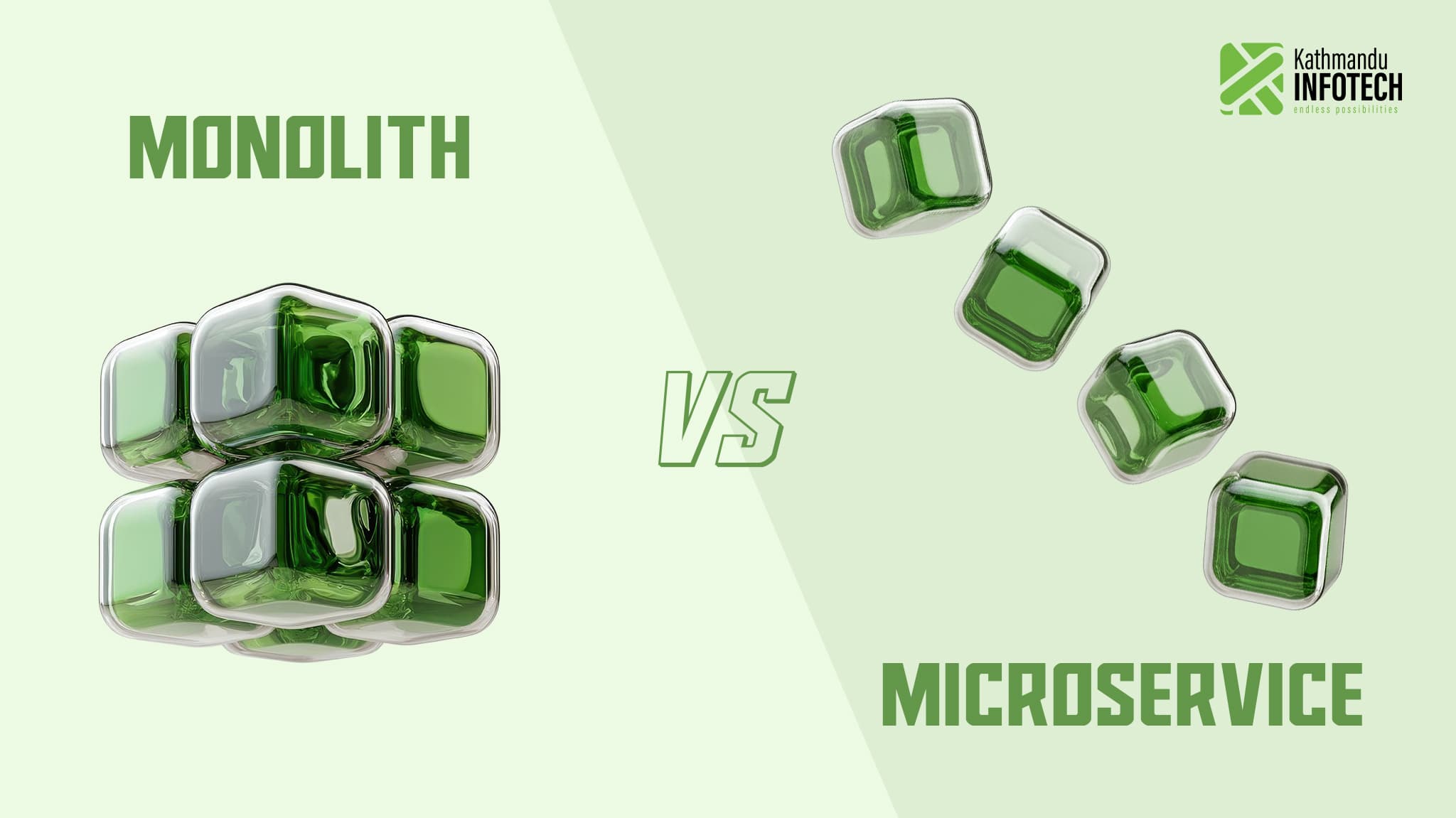
In the ever-evolving landscape of software development, choosing the right architecture can make or break a project's success. Two dominant paradigms—monolithic architecture and microservices architecture—have shaped how teams build scalable, maintainable applications. At Kathmandu Infotech, we've guided numerous clients through these choices, from startups bootstrapping their first MVP to enterprises refactoring legacy systems.
Software architecture isn't just about code; it's about aligning technology with business goals. In 2025, with cloud-native apps, AI integrations, and edge computing on the rise, monolithic apps (think a single, unified codebase) feel like relics of the 2000s, while microservices (decomposed, independent services) promise agility but demand orchestration wizardry.
According to a 2024 O'Reilly survey, 70% of organizations use microservices, up from 49% in 2020, yet 62% report deployment challenges. Monoliths, meanwhile, power 80% of small-to-medium apps due to simplicity. The choice? It depends on team size, scalability needs, and domain complexity.
This post breaks it down: We'll define each, contrast them, explore frameworks like Express.js and Spring Boot, detail project development, blending hybrids, migrations (both ways), implementations with code, pros/cons, and FAQs. By the end, you'll have the tools to decide—or hybridize.
Monolithic architecture is the traditional "all-in-one" approach where an entire application lives in a single codebase and deployable unit. Imagine a castle: one massive structure housing everything—UI, business logic, data access, and integrations—behind thick walls. Changes to any part require rebuilding and redeploying the whole castle.
At its core, a monolith is:
This design dates back to the 1960s mainframes but exploded with web apps in the 1990s (e.g., early e-commerce sites).
Monoliths ruled because early hardware was monolithic—limited RAM meant cramming everything together. In the Java EE era, frameworks like Struts enforced this. Today, they're ideal for simple CRUD apps or when rapid prototyping is key.
Consider "ShopMonolith," a basic online store built in Laravel (PHP). The app handles user auth, product catalog, cart, payments, and inventory in one repo.
app/
├── Models/          # Eloquent ORM models (User, Product, Order)
├── Controllers/     # HTTP handlers (AuthController, CartController)
├── Views/           # Blade templates for UI
└── Routes/ # web.php defining all endpointsPros for startups: Kathmandu Infotech built a client's inventory app this way—deployed in hours, zero orchestration.
Challenges emerge at scale: If payments spike, you scale the whole app, wasting resources on idle catalog code.
In 2025, monoliths thrive in serverless (e.g., AWS Lambda functions as a "fat" handler) or edge apps where latency trumps modularity.
Microservices flip the script: An app is a suite of small, independent services, each owning a bounded context (e.g., "user service" handles auth, "order service" manages transactions). They communicate via APIs (REST, gRPC) or messages (Kafka), deployed separately.
Coined by Martin Fowler in 2014, it's inspired by Unix's "do one thing well" philosophy. Each service is:
The "micro" isn't size—it's scope: Services should be <100 files, <10 endpoints.
Born from SOA's ashes (too heavyweight), microservices exploded with Netflix's 2008 shift from monolith to 700+ services. Amazon's "two-pizza teams" (services small enough for two pizzas) popularized it. In 2025, Kubernetes and service meshes like Istio make it feasible.
Netflix's monolith buckled under 1B+ streams/day. They decomposed:
A user watches a show → Event to Kafka → Rec Service updates prefs → Streams personalized content. Failure in recs? Others hum along.
At Kathmandu Infotech, we microservicized a fintech client's fraud detection: Separate "transaction" and "alert" services reduced downtime by 40%.
In 2025, with AI agents orchestrating services, microservices power 90% of Fortune 500 apps.
Monoliths are like a Swiss Army knife—versatile but bulky. Microservices? A toolkit of specialized scalpels—precise but fiddly to manage.
Here's a side-by-side comparison:
| Aspect | Monolithic Architecture | Microservices Architecture |
|---|---|---|
| Structure | Single codebase, one deployable unit | Multiple independent services |
| Scaling | Vertical/horizontal full app replication | Per-service scaling (e.g., Kubernetes pods) |
| Development Speed | Fast initial; slows with size | Slower start; consistent velocity |
| Fault Isolation | App-wide failure possible | Service failures contained |
| Tech Stack | Homogeneous (e.g., all Java) | Polyglot (Node, Python, Go) |
| Data Management | Shared DB, joins easy | Per-service DBs, eventual consistency |
| Deployment | Simple (one CI/CD pipeline) | Complex (multiple pipelines, blue-green) |
| Testing | End-to-end integration tests | Unit + contract + integration per service |
| Cost | Low for small apps; high maintenance | High ops; low per-service dev |
| Use Case Fit | MVPs, simple domains | Complex, high-traffic systems |
Example: In a monolith, updating a user profile cascades to inventory checks. In microservices, a "profile-update" event triggers inventory asynchronously.
Case Study: Uber started monolithic (2010) for speed, switched to microservices (2015) for 1,000+ engineers, handling 15M rides/day.
Frameworks accelerate both but shine differently. Monoliths favor full-stack batteries-included (e.g., Rails); microservices prefer lightweight, API-focused ones.
Hybrids? Use monolith frameworks for core, micro ones for edges.
Example Project: Blog App in Spring Boot.
Time: 2 weeks for MVP.
Example Project: E-Commerce Suite.
Time: 6 weeks, but parallelizable.
At Kathmandu Infotech, we use GitHub Actions for CI/CD in microservices, cutting release time to hours.
Pure monoliths or microservices? Rarely. 55% of teams (per 2024 CNCF survey) hybridize. Why? Leverage monolith simplicity with microservices scalability.
Wrap a monolith in microservices "shells" for gradual decomposition. The monolith is a "legacy service," fronted by new microservices.
Example: Banking app. Monolith handles core accounts; new "fraud-micro" service wraps it, adding ML checks. Code Snippet (Node.js Facade):
// facade-service.js (Express)
app.use('/api/accounts', proxy('http://monolith:8080/accounts', {
  filter: (req) => req.url !== '/legacy-endpoint' // Route new to micro
}));Start microservices-like inside a monolith, then extract. Use internal modules as "proto-services."
Example: E-Commerce. Monolith with "order-module" as a separate lib; later, spin it to AWS Lambda. Code Snippet (Nest.js Modular):
// order.module.ts
@Module({
  providers: [OrderService],
  exports: [OrderService] // For monolith use
})
export class OrderModule {}
// Later: Extract to microservice, inject via HTTP.
Case Study: Kathmandu Infotech's hybrid for a retail client: Monolith core + 3 microservices for analytics. Reduced migration risk by 70%.
Migrate when:
Not if: Small team, low traffic—stick or hybridize.
Challenges: Distributed tracing, data sync (e.g., CDC with Debezium).
Example: Strangler in Laravel to Nest.js.
Case Study: Amazon migrated in waves (1990s monolith to 100s services), boosting deploy freq from daily to 100x/min.
Time: 6-18 months. Cost: 20-50% team bandwidth.
Rare (only 10% reverse, per DORA 2024), but viable for simplification.
When:
Not if: Services are mature, polyglot bliss.
Challenges: Losing autonomy; merge conflicts.
Example: From Express Micros to .NET Monolith.
// In Monolith: Program.cs
builder.Services.AddScoped<IOrderService, OrderService>(); // From micro
app.MapGet("/orders", async (IOrderService os) => await os.GetAll());
Case Study: Segment.io reversed to monolith in 2019, slashing latency 90%, simplifying for 50 devs.
Time: 3-9 months. Often cheaper than forward migration.
We'll implement a simple "User Management" feature in both architectures across frameworks. Assume: CRUD users with auth.
Monolith:
const express = require('express');
const app = express();
const { Pool } = require('pg'); // Shared DB
const pool = new Pool({ connectionString: process.env.DATABASE_URL });

app.use(express.json());

// Routes
app.get('/users', async (req, res) => {
  const result = await pool.query('SELECT * FROM users');
  res.json(result.rows);
});

app.post('/users', async (req, res) => {
  const { name, email } = req.body;
  const result = await pool.query('INSERT INTO users (name, email) VALUES ($1, $2) RETURNING *', [name, email]);
  res.status(201).json(result.rows[0]);
});

app.listen(3000, () => console.log('Monolith on 3000'));
Deploy: node app.js.
Microservices:
// user-service/app.js
const express = require('express');
const app = express();
const pool = new Pool({ connectionString: process.env.USER_DB_URL });

app.get('/users', async (req, res) => { /* same query */ });
app.post('/users', async (req, res) => { /* same insert */ });

app.listen(3001);Nest.js (Angular-inspired, TS) excels in both.
Monolith:
// app.module.ts
import { Module } from '@nestjs/common';
import { TypeOrmModule } from '@nestjs/typeorm';
import { UserModule } from './user/user.module';

@Module({
  imports: [TypeOrmModule.forRoot(), UserModule],
})
export class AppModule {}

// user.controller.ts
import { Controller, Get, Post, Body } from '@nestjs/common';
import { UserService } from './user.service';

@Controller('users')
export class UserController {
  constructor(private userService: UserService) {}

  @Get()
  findAll() { return this.userService.findAll(); }

  @Post()
  create(@Body() createUserDto: CreateUserDto) { return this.userService.create(createUserDto); }
}
Shared DB in root.
Microservices:
// main.ts
import { NestFactory } from '@nestjs/core';
import { Transport } from '@nestjs/microservices';
import { AppModule } from './app.module';

async function bootstrap() {
  const app = await NestFactory.createMicroservice(AppModule, {
    transport: Transport.TCP,
    options: { host: 'localhost', port: 3001 },
  });
  await app.listen();
}
bootstrap();
Gateway uses HTTP client.
Nest's decorators make migration easy.
Monolith:
// UserController.java
@RestController
@RequestMapping("/users")
public class UserController {
  @Autowired private UserRepository repo;

  @GetMapping
  public List<User> all() { return repo.findAll(); }

  @PostMapping
  public User create(@RequestBody User user) { return repo.save(user); }
}

// application.yml: spring.datasource.url=jdbc:postgresql://localhost:5432/shared
One JAR.
Microservices:
// bootstrap.yml: spring.cloud.service-registry.auto-registration.enabled=trueSpring's Boot + Cloud = enterprise microservices powerhouse.
Monolith (Native):
// routes/web.php
Route::get('/users', [UserController::class, 'index']);
Route::post('/users', [UserController::class, 'store']);

// app/Http/Controllers/UserController.php
class UserController extends Controller {
  public function index() {
    return User::all();
  }
  public function store(Request $request) {
    return User::create($request->all());
  }
}
Eloquent shared.
Microservices: Use Lumen (lightweight Laravel) per service.
Monolith (ASP.NET Core):
// Startup.cs
services.AddDbContext<AppDbContext>(options => options.UseSqlServer(connectionString));

// UsersController.cs
[ApiController]
[Route("users")]
public class UsersController : ControllerBase {
  private readonly AppDbContext _context;
  public UsersController(AppDbContext context) { _context = context; }

  [HttpGet] public async Task<IActionResult> Get() => Ok(await _context.Users.ToListAsync());
  [HttpPost] public async Task<IActionResult> Post(User user) {
    _context.Users.Add(user); await _context.SaveChangesAsync(); return CreatedAtAction(nameof(Get), user);
  }
}
One project.
Microservices: Separate APIs, use Ocelot for gateway.
// Program.cs in UserService
builder.Services.AddDbContext<UserDbContext>(options => options.UseSqlServer("UserConn"));
EventBus with MassTransit.
Django (Python) Monolith:
# views.py
from django.http import JsonResponse
from .models import User
def users(request):
    if request.method == 'GET': return JsonResponse(list(User.objects.values()), safe=False)
    # POST logic
Shared SQLite/Postgres.
Microservices: DRF (Django REST) per service, Celery for async.
Quarkus (Java) Micro:
@Path("/users")
public class UserResource {
  @Inject UserRepository repo;
  @GET public List<User> get() { return repo.listAll(); }
}
Native compile for fast starts.
These implementations highlight: Monoliths = quick vertical slices; Micros = horizontal autonomy. At Kathmandu Infotech, we prototype in monoliths, scale to micros.
Pros:
Cons:
Pros:
Cons:
Table Summary:
| Pros/Cons Category | Monolith Pros | Monolith Cons | Microservices Pros | Microservices Cons |
|---|---|---|---|---|
| Development | Fast prototyping | Coupling issues | Independent teams | Contract testing |
| Operations | Simple deploys | Risky changes | Fault isolation | Monitoring sprawl |
| Performance | Low latency | Hard scaling | Fine-grained scale | Network overhead |
| Cost | Low entry | High maint. | Long-term savings | High upfront |
Balance: Use monoliths for 80% of apps; micros for scale beasts.
Basecamp (formerly 37signals) stuck with Rails monolith for 20+ years, handling 100k users. Why? Simplicity > hype. Deploys in minutes, zero service sprawl.
Fail: A 2012 e-commerce monolith at a retailer crashed during holidays—full scale couldn't isolate payments.
Spotify's 500+ services (backends in Java/Go) enable personalized playlists for 500M users. Squad model + domain graphs keep chaos at bay.
Fail: Early Twitter microservices (2008) led to "Fail Whale"—too many hops.
Hybrid Win: Kathmandu Infotech's 2024 project for a logistics firm: Monolith core + micro for tracking. 50% faster iterations.
Future: Serverless micros (Knative) blur lines.
Neither—context-dependent. Monoliths for simplicity; microservices for scale. Start monolithic, evolve.
Monolith to micro: 6-18 months. Reverse: 3-9. Pilot one service first.
Yes, but sparingly—e.g., 3-5 services. Avoid if <5 devs.
Monolith: $500/month AWS t3.medium. Micro: $2k+ with K8s, but scales efficiently.
Per-service DBs + events. Use Outbox pattern for reliability.
Nest adds structure (modules, guards); Express for ultra-light. Nest for teams >3.
Gradual replacement: New code "strangles" old, like a fig tree overtaking a host.
Yes—containerize with Docker, deploy to ECS/Fargate.
Rapid CRUD, ecosystem (Forge for deploys).
If ops >20% time, latency >200ms, or team <10.
More FAQs? Comment below!
Monoliths offer a sturdy foundation; microservices, agile wings. At Kathmandu Infotech, we advocate "right-sized" architecture: Prototype monolithic, decompose strategically, hybridize boldly. Whether Express APIs or Spring empires, the goal is velocity + reliability.
Ready to build? Contact us for a free architecture audit. What's your next project—monolith fortress or microservices fleet?


YouTube stands as the world’s leading video platform, boasting over 2.7 billion monthly active users and billions of hours of watch time every day. In this highly competitive and fast-evolving ecosystem, mastering YouTube SEO and video advertising is no longer optional—it is essential for creators, businesses, and marketers aiming for higher rankings, stronger engagement, sustainable growth, and effective monetization.

GTM, launched in 2012, is a tag management system that centralizes the deployment of tracking scripts, pixels, and snippets. It operates via a JavaScript container (gtm.js) that dynamically loads tags based on user-defined rules. In 2025, GTM supports web, AMP, iOS, and Android containers, with server-side tagging for enhanced privacy. GTM’s API and version control make it ideal for enterprise-scale deployments.

Discover how to build a powerful email automation ecosystem with proven strategies, the right tools, and best practices. Learn about triggers, lead generation, journey design, and platform selection to boost engagement and conversions.

Celebrate Dashain 2025 with Kathmandu Infotech’s Special Offer! Get up to 30% off on digital marketing, web development, SEO, and IT solutions in Kathmandu. Elevate your brand this festive season.

In today’s fast-paced digital world, a logo is more than just a pretty image—it’s the face of your brand. It communicates who you are, what you do, and what your audience can expect from you. A well-designed logo can create a lasting impression, while a poorly designed one can confuse or even repel potential customers.